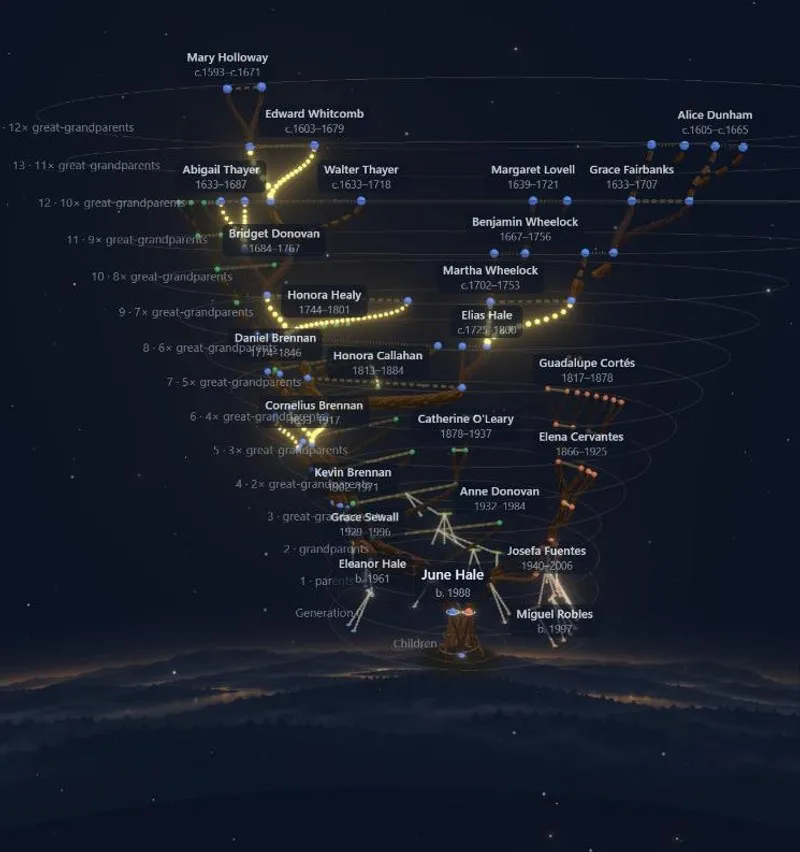
Tree
Generations rise in tiers. Each side of the family keeps its own slice, so lines never tangle.


Chart your origins.
Turn your family history notes into a 3D family tree you can walk around, see five ways, and share without giving away anyone still alive.
Runs in your browser. The sample tree needs no sign-up, and the family in it is made up.
Five views of one family
Every view is built from the same notes and the same people. Switch between them with one click and watch everyone glide to their new place.
Generations rise in tiers. Each side of the family keeps its own slice, so lines never tangle.
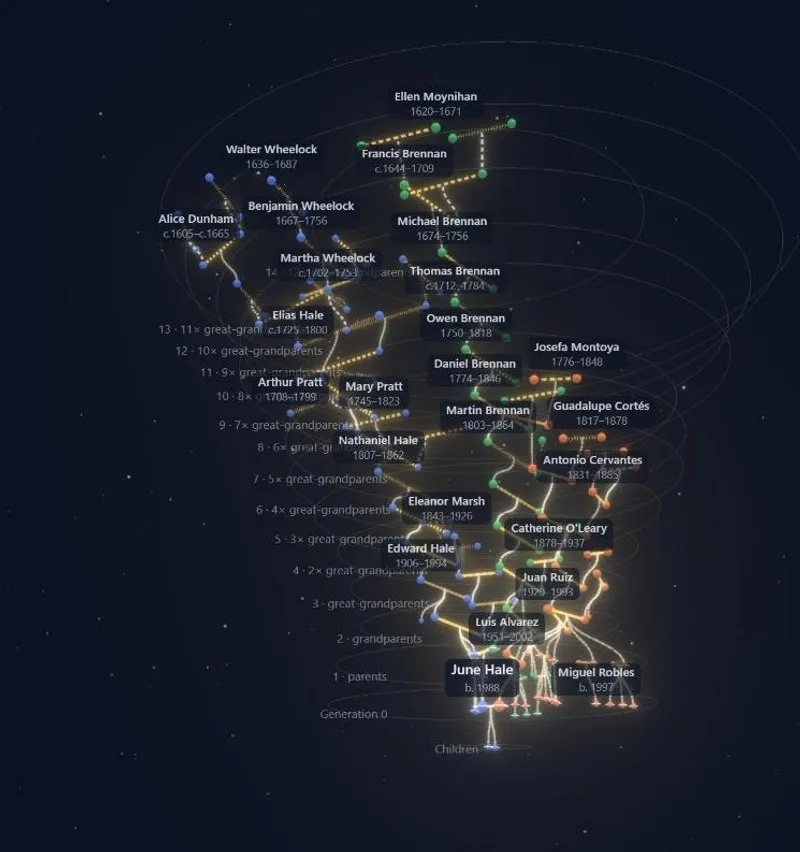
Follow every line. Look up through the generations to the lives that came before.
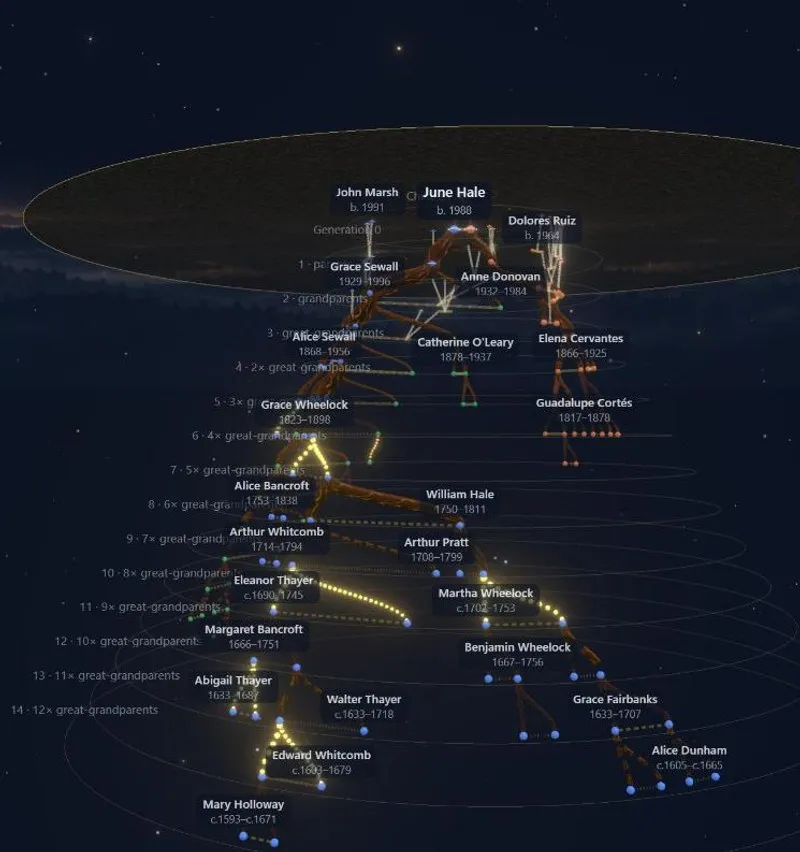
Deep beginnings, new growth. Ancestors spread below the ground; the youngest grow above it.
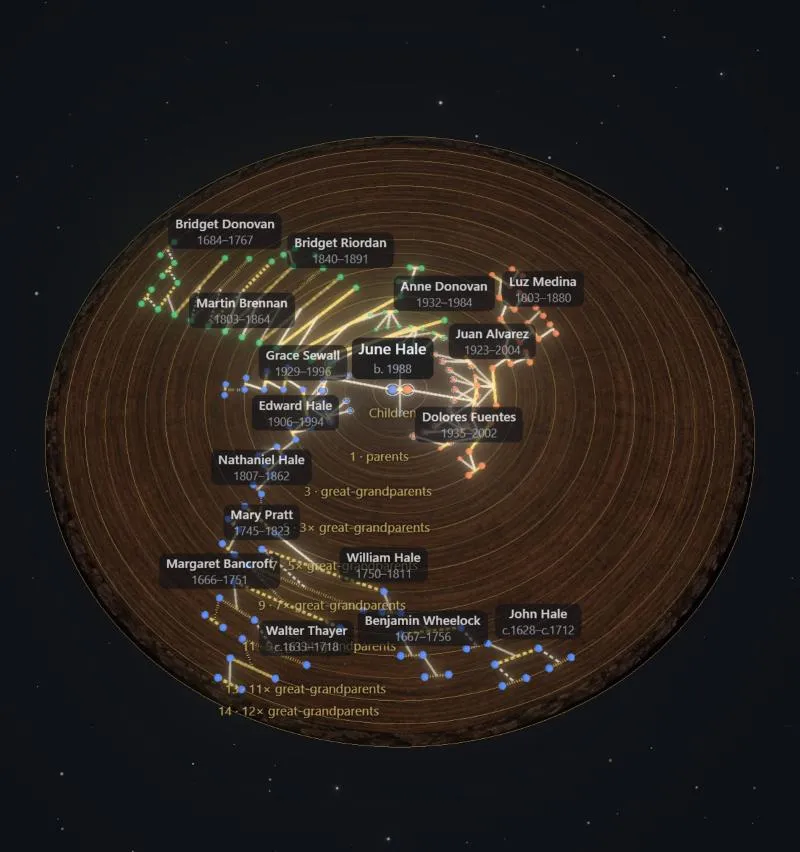
Read the rings. You at the heart, every generation one ring further out, or one ring for every decade.
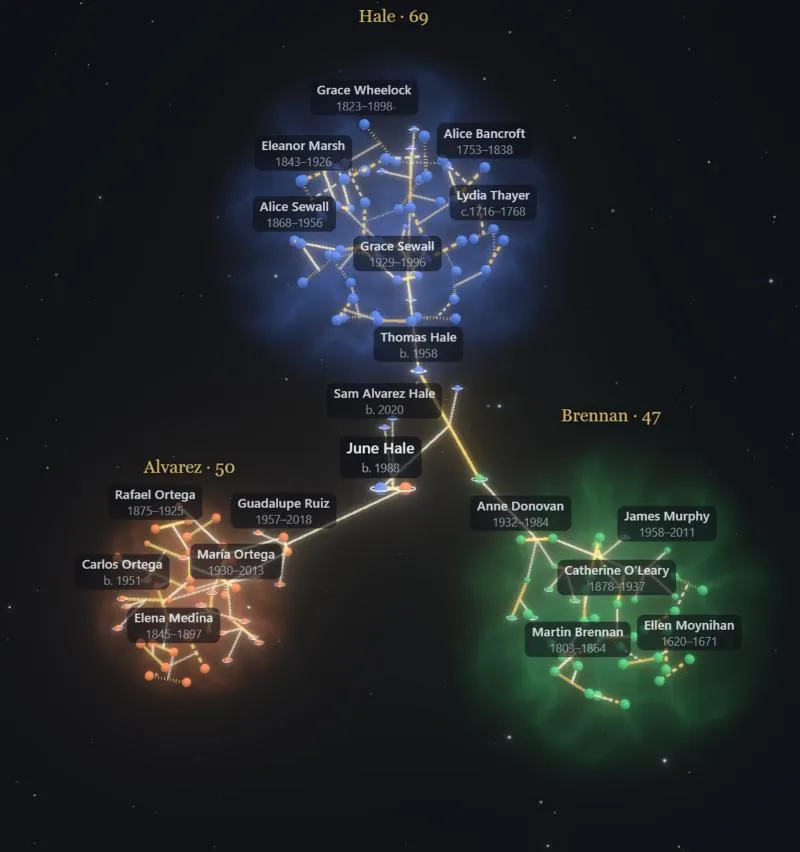
A sky full of stories. Each side of the family glows as its own cloud, with marriages as threads between them.
Made for real research
Cartogeny reads a folder of plain Markdown notes, one per person, the way genealogists already keep them in Obsidian. It only reads; your research stays in files you own, forever, and nothing is uploaded.
Each parent and partner link is drawn by how sure you are, so a hunch never looks like a proven fact.
Shared copies turn everyone still living into just “Living”: no names, dates or places. Before a copy is saved, Cartogeny checks it, and refuses if anything slipped through.
Your tree is a single page that opens in any modern browser, on a laptop or a phone, online or off. Email it, put it on a USB stick, keep it for the grandchildren.
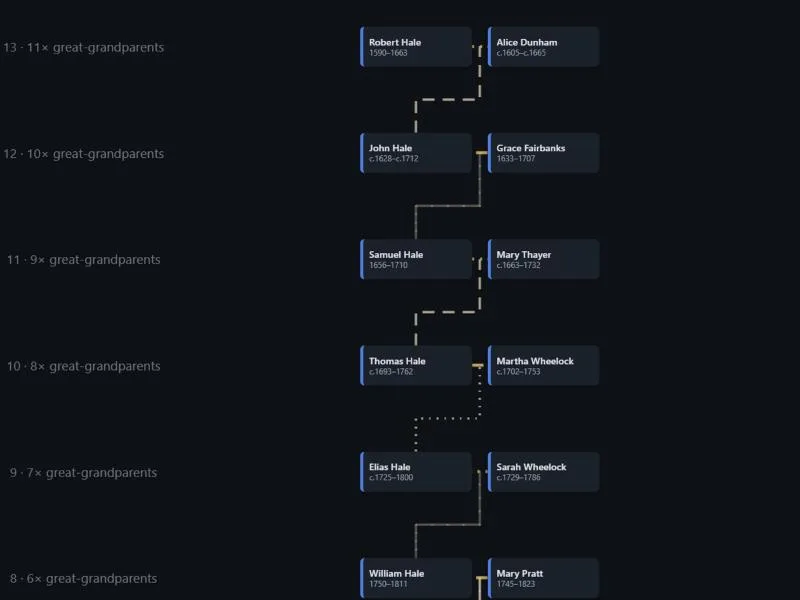
Pick a person or a family line and the 3D tree folds into a tidy 2D chart of name cards, ready to print or save as a picture for the next reunion.
Bring your own tree
Cartogeny reads a folder of plain notes, one per person, the kind you can keep in Obsidian or any text editor. They're ordinary files on your own computer: no subscription, and nothing to export when you leave.
A few properties at the top of each note, and a Family section that links parents, partners and children. One page covers all of it.
Read the note formatBegin from the starter vault: three example people and a template for new ones. Or, if your tree is on Ancestry, turn its export into a vault with a note for every person.
Download the starter vault Make a vault from your Ancestry export →Choose your folder and your tree grows in front of you. It's read right there in your browser; nothing is uploaded. Opening a folder needs a computer: phone browsers can't.
$29, once. Sign in with your email, pay one time, and it's yours to keep.
Open your own vaultAlready have notes and a tree on Ancestry? Save its export in your vault and Cartogeny adds the people you haven't written up yet, while your notes always win.
Meet the Hales
June Hale, her partner Mateo Alvarez, and 164 relatives reaching back to the 1580s, across England, Ireland, Mexico and America. None of them are real.